Live pressure, safe boundaries
Employees rehearse deception inside bounded, supervised scenarios that feel real enough to matter without creating uncontrolled risk.
Managing Human-Layer Risk
Robot-Powered Fraud Is Going Vertical
Deloitte projectionProjected U.S. GenAI-enabled fraud losses, 32% CAGR.
Wolfmasking saves your at-risk employees by putting them in the role of the deceiver. Through supervised scrimmages, they build an internal map of how deceivers think, empowering them to instinctually avoid them.
Brian Brushwood has spent decades teaching millions how scams, persuasion, social engineering, and deception actually work. Wolfmasking turns that expertise into enterprise deception role-play training that helps at-risk employees recognize pressure, slow down, verify, and escalate before an attack turns into loss.
Led by Brian Brushwood, deception educator and host of World's Greatest Con. Built for security and IT leaders responsible for human-layer risk.
The Solution Gap
Security and IT leaders already know the pattern: stronger controls, better identity tooling, more awareness content, and yet the human layer stays exposed to urgency, spoofed authority, social pressure, and believable context.
Your employees have the knowledge. What they need are instincts. Wolfmasking makes that possible.
Wolfmasking is the only training that trains instinct by putting employees in the role of deceiver—crafting deceptions so they can recognize them a mile away.
Watch Pilot KeynoteWhy This Is Different
Traditional awareness programs mostly target recall. Real scams target urgency, authority, fear, opportunity, trust, and embarrassment. Wolfmasking is built to address that mismatch.
But under pressure, employees rely on System 1 thinking. Wolfmasking trains those fast instincts so people can recognize manipulation before their slower reasoning catches up.
Featured Talk
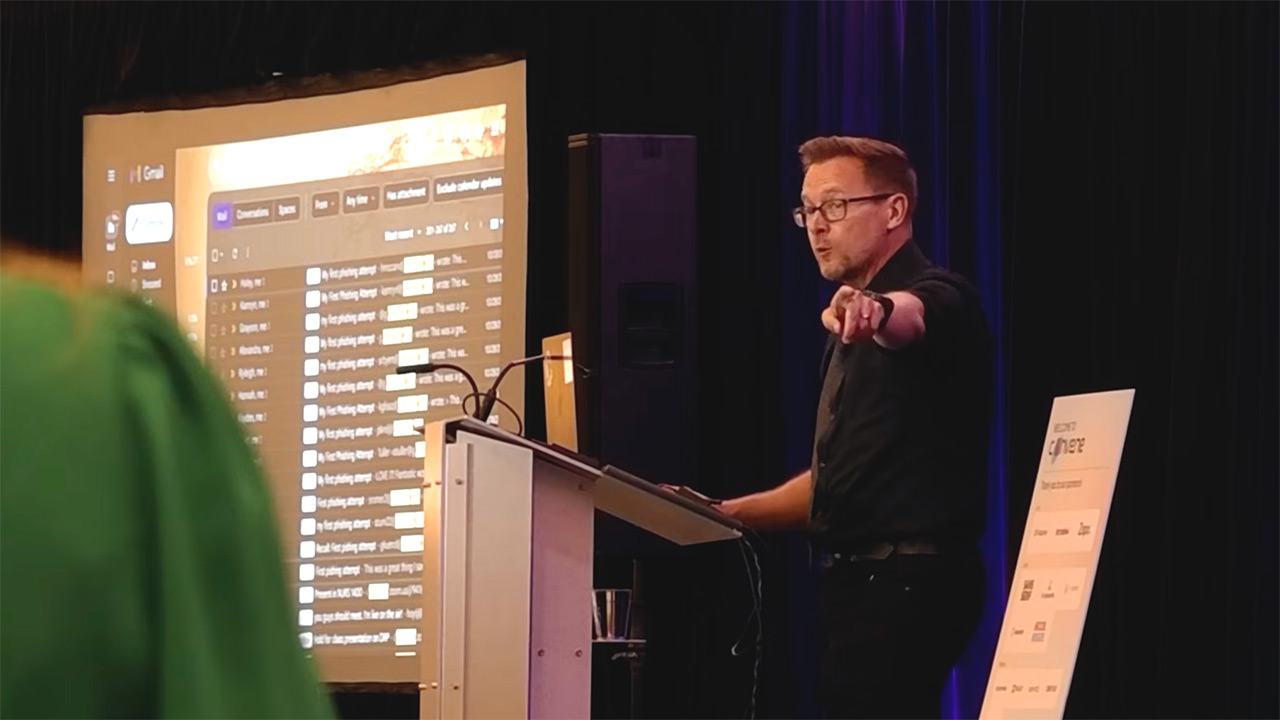
Brian explains why passive security training fails against modern social engineering, and how Wolfmasking turns scam mechanics into practiced defensive instincts.
Employees rehearse deception inside bounded, supervised scenarios that feel real enough to matter without creating uncontrolled risk.
High-risk employees get an active intervention instead of another passive module, another quiz, or another round of shame.
Brian Brushwood brings an unusual mix of deception literacy, facilitation skill, and live audience command that helps the training land.
The pilot creates observed patterns, scorekeeping, and practical next-step recommendations security and IT leaders can take upward.
Why Brian Matters

Brian Brushwood has spent decades publicly teaching how scams, persuasion, social engineering, and deception actually work. That background gives Wolfmasking a level of realism and engagement most awareness programs do not have.
Wolfmasking turns Brian's deception expertise into a format your teams can absorb, remember, and apply when an attack feels plausible instead of obvious.
The Wolfmasking R.E.A.D. Method
The point is not spectacle. The point is firsthand understanding of how deceptive pressure is rendered, enhanced, attempted, and defeated.
Wolfmasking Fixes Instinct
Zero-to-One: Participants make a simple deceptive message or scenario visible and concrete so manipulation mechanics are easier to recognize.
They improve it with timing, authority, urgency, context, and plausibility to understand how deception gains force.
PvP Attacks: They run supervised peer-to-peer attempts inside the cohort in a controlled, ethical environment.
They catch, report, and respond after having briefly inhabited attacker logic firsthand.
Operating Model
Wolfmasking teaches attacker logic in a safe, supervised, and engaging format. As employees play a light competitive season, they model predator instincts in a bounded setting so those instincts become easier to recognize in the wild.
Wolfmasking's Unique Approach
Exercises avoid real passwords, payment actions, or credential capture.
Scenarios are constrained to the population, policies, and risk patterns agreed in discovery.
Participants operate inside a facilitated cohort with clear boundaries and structured debriefs.
The outcome is improved recognition and reporting behavior plus practical organizational insight.
What You Get
As employees model the predator, they reveal stress points in your organization. Deadlines, double-binds, and conflicting incentives reveal themselves in their deceptive attempts. During the PvP round, company-wide strategic insights emerge, producing a real-time heat map of anxieties and vulnerabilities.
Where employees hesitate, comply, verify, or report under deceptive pressure.
Which roles, workflows, and assumptions create the clearest openings for social engineering.
A concise readout that connects cohort behavior to practical risk-reduction decisions.
Concrete next steps for training, reporting, and targeted reinforcement after the pilot.
Best First Cohorts
Who Wolfmasking Is For
For employees who need transformation, not just a fresh reminder that they failed a test.
For leaders targeted through impersonation, urgency, and access-driven manipulation.
For teams exposed to payment fraud, approval spoofing, and authority-based deception.
For functions handling identity claims, sensitive records, and high-volume external interactions.
For groups whose work, relationships, or access patterns make them attractive deception targets.
Founding Pilot
A 4-week live cohort (1hr session per week) for 25-100 priority participants: repeat clickers, finance, HR/recruiting, executives, and privileged-access teams.
Pilot Outcome
Wolfmasking helps your most exposed employees understand how the predator thinks, so the next real attempt feels familiar before it feels persuasive.
Founding keynote
See how Brian transformed 80 nursing freshman into weapons-grade cybersecurity predators.
FAQ
No. Phishing tests measure whether someone clicks. Wolfmasking trains people to understand why a deceptive message works and how to resist the pressure in real time.
Most awareness training improves recall. Wolfmasking is designed to improve behavior under live pressure through rehearsal, supervised attack logic, and defensive response practice.
While the Wolfmasking pilot program focuses on phishing, future seasons are planned to address deepfakes and physical attacks.
The pilot is designed around bounded scenarios, approved scope, and clear rules. No real credentials, payment actions, or uncontrolled exercises are used.
Good first cohorts include repeat-click intervention populations, finance, executives, HR/recruiting, and teams exposed to impersonation or sensitive access.
First we play the game, build the world, learn where people get stuck, and use pilots to discover the strongest repeatable model. To scale, we'll use an LLM trained on the data gleaned from multiple pilots as well as Brian's 25 years of deception teaching.
Leadership gets observed patterns, cohort-level learning, scorekeeping, and practical recommendations for reducing human deception risk.
Founding Pilot Briefing
Request a focused conversation on fit, cohort design, target population, and what a Brian Brushwood-led pilot could look like inside your organization.
Pilot Details
Enter your information to unlock the founding pilot keynote.
Founding Pilot Keynote
Watch the keynote below.
If the embedded player is blocked, open the video on YouTube.